December 3, 2025
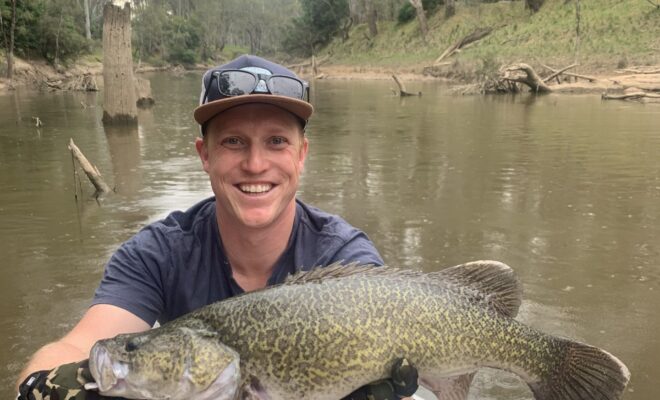
Photo: VRFish Executive Officer, Anthony McGrath, pictured with a Murray cod caught in the Goulburn River at natural water levels
Murray cod season opening, on 1 December, is one of the most anticipated days on the freshwater fishing calendar and families often make plans for their season opening fishing trips months in advance.
In the lead up to Murray cod season, VRFish was alerted to an inter-valley transfer that was going to be released into the Goulburn River, below Nagambie. This section is known as Victoria’s premier Murray cod river fishery and these flows had the potential to ruin the plans of thousands of fishers.
An inter-valley transfer (IVT) refers to the bulk transfer of water from the Goulburn water supply system to supply water users in the Murray water supply system. The IVT was requested by the Murray-Darling Basin Authority. These flows are in the form of a pulse – a short-term increase in the river’s flow – from Goulburn Weir.
For several days, the pulse flows tend to make the river unfishable and will often flood popular campsites in the area. Due to increased river height and speed, boat fishing can become difficult, and the conditions result in muddy and slippery riverbanks – making them unsafe for bank fishers. The pulse flows also cause native fish to seek refuge and stop feeding.
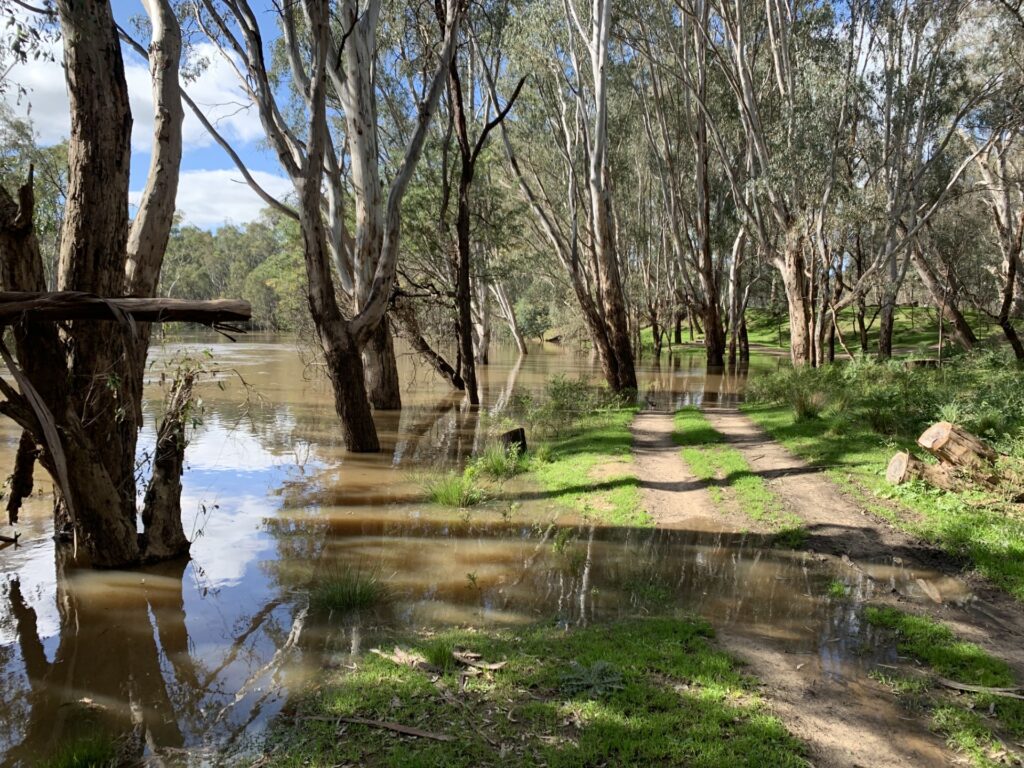
Upon learning of the scheduled pulse flow from outraged fishers all over the state, VRFish and our affiliated clubs in the Goulburn Valley worked with the Victorian Fisheries Authority to request a delay in the timing of the flow.
VRFish understands the importance of water for our farmers downstream, and we’re always willing to work with water authorities to find the balance between supplying water allocations and peak periods of public use. We also understand that the integrated channel system can be used for many of these water transfers.
Following the concerns raised by the fishing community, Goulburn Broken CMA worked with Goulburn-Murray Water and Murray-Darling Basin Authority to postpone the water delivery. The pulse commenced on 2 December from Goulburn Weir.
According to Goulburn-Murray Water, releases from the weir will increase daily from 1550 megalitres per day on 2 December to a peak of around 3000 megalitres per day on 4 December. Flows will then reduce daily to around 1100 megalitres per day by 14 December at Murchison and by 18 December at McCoy Bridge.
VRFish supports the outcome that was achieved, but the stress caused to fishers and campers was entirely preventable. We’re offering to work with irrigators and water managers to ensure that important dates on the recreational fishing calendar are considered in relation to IVT’s and environmental flows. These include school holidays and the opening weekends for Murray cod, trout and Murray spiny freshwater crayfish.
With over 1 million recreational fishers in Victoria, we know that fishing-based tourism provides a significant economic boost to communities along the river.
What’s flowing in the Goulburn?
Recreational fishers often ask us about the flows in the Goulburn River as there can be a range of water flows through the river at different times of the year such as natural flows, inter-valley transfers (IVTs), and environmental water.
The Goulburn Broken Catchment Management Authority have a fantastic resource on their website, a hydrograph, which shows the flows measured at McCoy’s Bridge in the lower Goulburn River over time. It’s updated weekly.